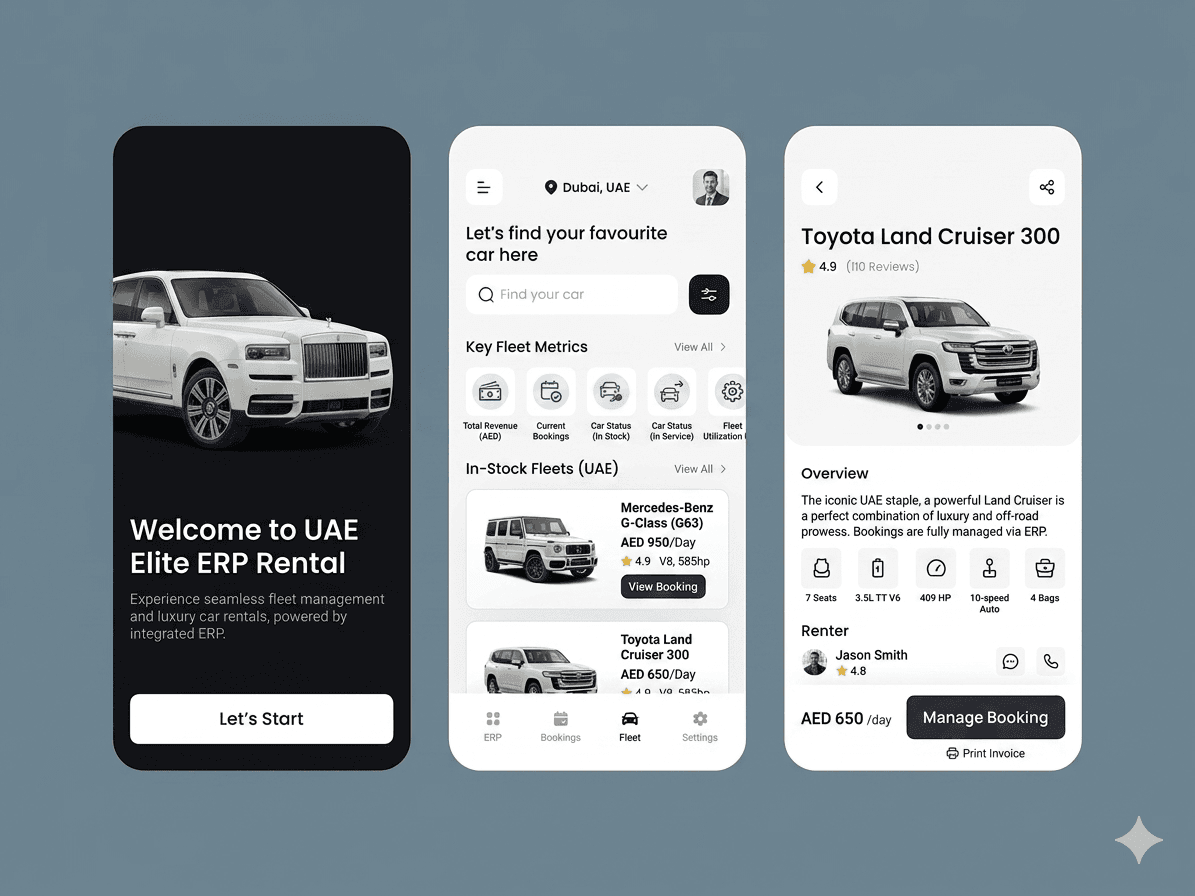
ERP Car Rental
End-to-end ERP for car rental businesses: fleet, bookings, billing and maintenance as four bounded modules, with GPS telemetry on a separate ingestion path.
1000+
Vehicles Managed
99.9%
Uptime
24/7
GPS Tracking
01 // Overview
Car Rental ERP System
A comprehensive enterprise resource planning platform built specifically for car rental companies. From fleet management and online bookings to automated billing and maintenance tracking - everything needed to run a modern car rental business efficiently.
Fleet Management
Complete vehicle tracking, availability management, assignment monitoring, and real-time GPS location tracking.
Online Booking System
Customer-facing reservation platform with vehicle selection, pricing calendar, and instant booking confirmation.
Automated Billing
Invoice generation, payment processing, contract management, and automated late fee calculations.
02 // Features
ERP Capabilities
GPS Tracking
Real-time vehicle location monitoring, route history, geofencing alerts, and driver behavior tracking.
Maintenance Scheduler
Automated service reminders, repair tracking, vehicle health scoring, and cost analysis per vehicle.
Business Analytics
Revenue reports, utilization metrics, customer insights, and predictive analytics for fleet optimization.
Engineering
The Decisions Behind It.
What made this hard?
The biggest risk in an ERP is that fleet, bookings, billing, and maintenance become so tangled that changing one module breaks the rest.
How was the system structured?
Four bounded modules: fleet, bookings, billing, and maintenance. Each owns its data and talks to the others through defined interfaces rather than reaching into their tables. GPS telemetry arrives on a separate ingestion path so high-frequency location data never slows the transactional workload.
What does the codebase look like now?
Billing calculations are pure functions, which makes them easy to test and lowers the regression risk when pricing rules change. Module boundaries and data ownership are written into an architecture document that is the first step of onboarding.