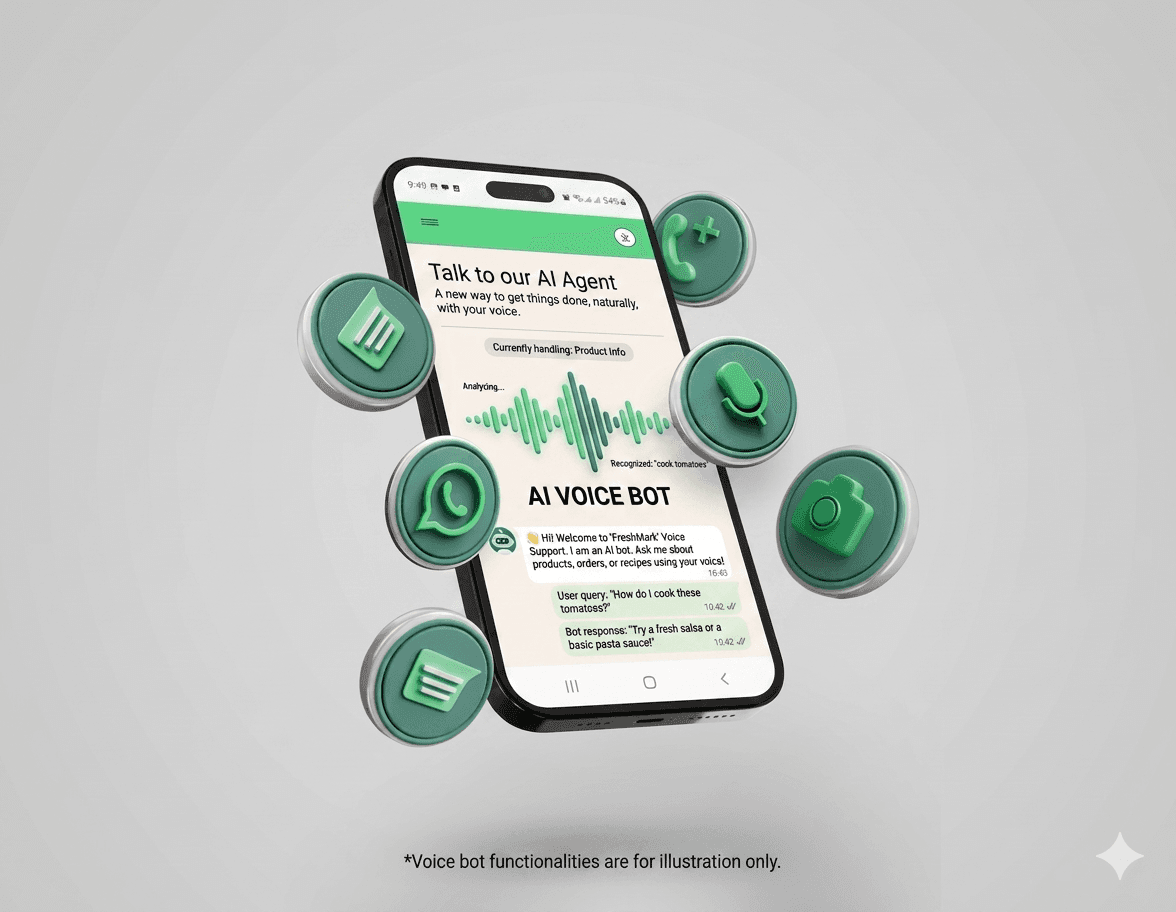
WhatsApp Voice Bot
A WhatsApp bot that transcribes incoming voice notes and replies with context-aware answers from OpenAI GPT models, built in Python on the WhatsApp Business API.
1000+
Messages Handled
1 week
Build Time
Any
Language the User Speaks
01 // Overview
From Voice Note to Reply
A voice message arrives on WhatsApp, gets transcribed to text, and goes to an OpenAI GPT model that writes the reply, which the bot sends back in the same chat.
Voice-to-Text Processing
Fetches the audio from WhatsApp and converts it to text before it reaches the model.
AI Response Engine
Writes each reply with an OpenAI GPT model, given the transcribed message and the conversation so far.
WhatsApp Business API
Receives messages through a WhatsApp Business API webhook and sends replies back through the same API.
Engineering
The Decisions Behind It.
What made this hard?
Turn a voice message into text and return a context-aware LLM reply inside WhatsApp's webhook timeout, where every second counts against you.
How was the system structured?
The webhook receiver is separated from the processing pipeline, so WhatsApp gets an immediate acknowledgement while transcription and inference run in the background. The pipeline splits into three discrete stages: media fetch, speech to text, and response generation, each independently testable and replaceable.
What does the codebase look like now?
Every external dependency sits behind its own adapter module, so swapping a provider never touches business logic. The setup guide documents webhook verification, environment variables, and sandbox testing, so any developer can run the bot locally.
02 // Features
Key Capabilities
Any Language
Understands and replies in whatever language the user speaks, with no language list to configure.
Conversation Context
Keeps the conversation history so a follow-up question is answered in context.
03 // Role and Result
What I Built and What It Did
I designed and built the whole system myself in one week: the webhook, the processing pipeline and the integrations behind it. It has handled 1000+ messages, the client was very satisfied, and it saved them time on the conversations it now answers.
Replies Inside WhatsApp's Time Limit
The webhook acknowledges WhatsApp immediately and hands the work to a background pipeline, so slow transcription or model calls never cause a timeout.
Three Independent Stages
Media fetch, speech to text and response generation are separate steps, so each can be tested and replaced without touching the others.
Providers Are Swappable
Every external service sits behind its own adapter, so changing the speech or language model provider does not touch the business logic.