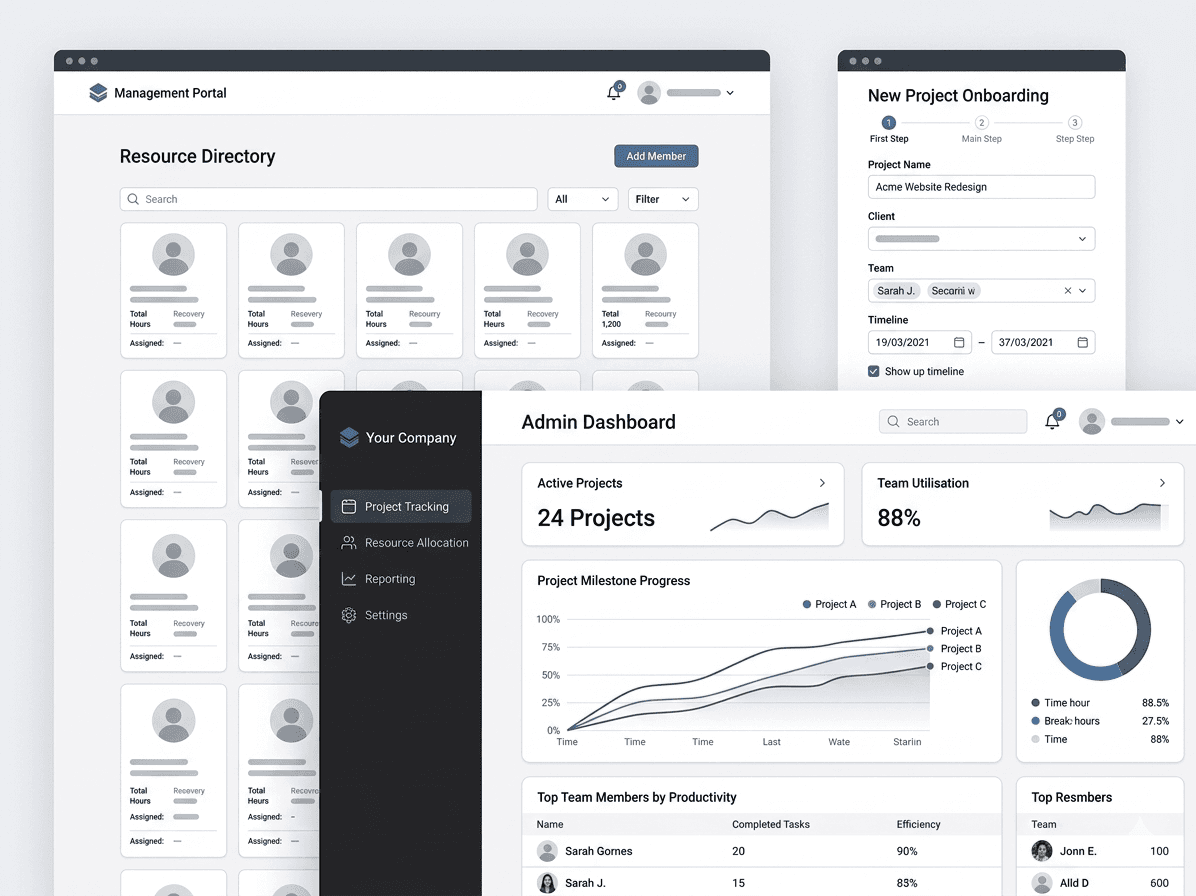
Internal Management System
Internal operations platform for team management, task workflows and resource planning, with permissions coming from one central policy layer per module.
100+
Team Members
500+
Tasks/Month
99%
Uptime
01 // Overview
Operations Management Platform
A comprehensive internal management system designed to streamline team operations, automate workflows, and provide real-time visibility into project progress and team performance. Built for scaling organizations.
Team Management
Complete employee profiles, role-based permissions, attendance tracking, and performance reviews in one place.
Task Tracking
Create, assign, and monitor tasks with deadlines, priority levels, and automated reminders for accountability.
Workflow Automation
Automate repetitive processes, approval chains, and operational workflows to boost team productivity.
02 // Features
Platform Capabilities
Real-time Dashboards
Live KPI tracking, team performance metrics, and operational insights with customizable reporting.
Resource Planning
Optimize team capacity, manage workloads, and prevent burnout with intelligent resource allocation.
Audit & Compliance
Complete activity logs, version history, and compliance tracking for accountability and governance.
Engineering
The Decisions Behind It.
What made this hard?
Internal tools turn into a mess faster than anything else, because every team adds its own requirement and the system sprawls without a plan.
How was the system structured?
Modules break along feature boundaries: tasks, resources, and process automation, each with its own data ownership. Permissions come from a central policy layer, so adding a module does not mean writing access control again.
What does the codebase look like now?
Common patterns like list views, filters, and forms come from shared components, which gives consistency and cuts the development time for a new module. Each module's purpose and data model is written into the repo documentation.